

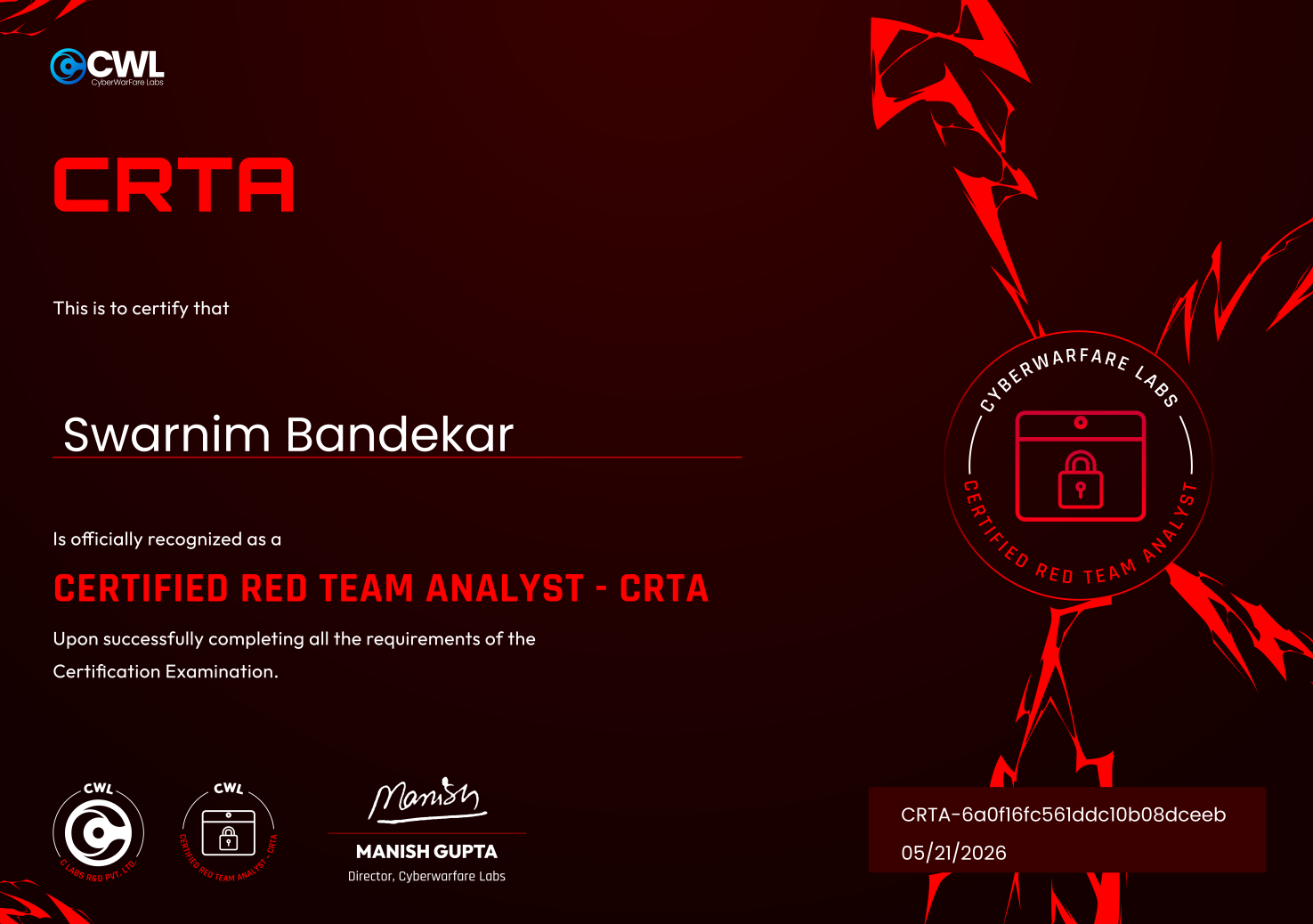
CRTA Exam Experience
Overview
This was my attempt at the Certified Red Team Analyst exam - a hands-on, Active Directory focused assessment that tests real-world offensive security skills from initial access all the way through to domain compromise.
First Impressions
Going into the exam, I felt a mix of excitement and nervousness. I knew the theory, had practiced in labs, but there’s always that uncertainty when you’re dropped into a live environment with a clock ticking. The scope was clear but the path wasn’t - exactly how a real engagement feels.
The Journey
Getting a Foothold
The first phase was all about reconnaissance. Connecting to the VPN and scanning the network felt routine at first, but I quickly realized the environment wasn’t going to hand me anything easily. I had to carefully enumerate services and figure out what each one was doing. Finding the initial web application and understanding its purpose took some patience.
Web Application Enumeration
Once I identified the web app, I spent a good chunk of time poking around its frontend, reading through bundled JavaScript, and mapping out API endpoints. There were some interesting findings hidden in plain sight - sensitive files sitting in asset directories, credentials embedded in stylesheets (even if marked as “dummy”), and API logic that revealed more about the application’s internals than intended.
Pivoting Internally
Discovering the internal network was a turning point. The monitoring service became my window into the system - I could read local files, understand the host configuration, and identify internal infrastructure. This is where things got interesting and started to feel like a real red team operation rather than just a web assessment.
The Frustrating Parts
Not everything went smoothly. There were moments where I hit walls:
- Credential reuse didn’t work where I expected it to
- Some endpoints were locked down tighter than anticipated
- The internal host required a different approach than I initially tried
- Time pressure made me second-guess myself on a few occasions
I found myself going back and forth between enumeration and exploitation, which is honestly how real engagements go. You think you have the answer, try it, fail, and then go back to gathering more information.
Active Directory Phase
The AD portion was where the complexity really ramped up. Moving from a Linux web server into a Windows domain environment required a mental shift. Finding the right credentials, understanding trust relationships, and ultimately working toward domain admin - each step had its own set of challenges.
What I Learned
- Patience pays off. Rushing through enumeration means missing things. The answers were often hiding in files or responses I almost skipped over.
- Take notes constantly. With multiple hosts, services, and credentials in play, keeping track of everything is essential.
- Think like a chain. Each finding is a link - a password here connects to access there, which reveals information that unlocks the next step.
- Don’t fixate. When something isn’t working, step back and try a different angle. The exam rewards creative thinking.
How I Felt
Honestly? It was a rollercoaster. Early wins gave me confidence, but the middle section - where you’ve found some things but can’t quite connect them all - was mentally draining. There’s a moment in every exam like this - where you wonder if you’re going to make it. But pushing through that doubt and staying methodical is what gets you to the finish line.
The Result
I passed with a 100% score - finished the entire exam in about 1 hour 30 minutes out of the 6 hours allotted. Honestly, I didn’t expect to clear it that fast. Once the pieces started falling into place, the momentum just carried me through. Every enumeration step fed into the next, and before I knew it, I had all the answers.
Final Thoughts
The CRTA exam is a solid test of practical offensive security skills. It doesn’t just check if you can run tools - it checks if you can think through problems, chain findings together, and maintain composure when things don’t go as planned. Finishing in a fraction of the allotted time with a perfect score felt incredible - a real validation of the hours spent practicing and building methodology.
Would I recommend it? Absolutely. It’s the kind of exam that makes you grow, but yeah I didn’t pay for it, I won this at some CTF.
CRTA Review: Is the Certified Red Team Analyst Certification Worth It?
If you landed here searching for an honest CRTA review, here’s my take. The Certified Red Team Analyst (CRTA) certification by CyberWarfare Labs is one of the most practical entry points into red teaming. Unlike multiple-choice tests, the CRTA exam is fully hands-on, dropping you into a live Active Directory environment where you chain web exploitation, internal pivoting, and domain compromise. For anyone serious about offensive security and a career in cybersecurity, the CRTA certification delivers real value.
So, is CRTA worth it? In my opinion, yes - especially if you want a budget-friendly, lab-based credential that proves you can actually operate, not just memorize. It builds the methodology and mindset you need before moving on to heavier certifications like CRTP (Certified Red Team Professional).
How to Pass the CRTA Exam
Based on my CRTA exam experience, here is how to pass the CRTA exam:
- Master enumeration first. Most of the CRTA exam is won during recon. Enumerate every service, read JavaScript bundles, and inspect API endpoints carefully.
- Practice Active Directory attacks. Understand Kerberos, credential reuse, lateral movement, and privilege escalation paths to domain admin.
- Take detailed notes. Track every host, credential, and finding - they connect like a chain.
- Stay calm under time pressure. You get six hours; methodical beats fast - I finished in about 1.5 hours.
- Build a repeatable methodology. The exam rewards process over luck.
CRTA vs CRTP
A common question in any CRTA exam review is how it compares to CRTP. The CRTA is more beginner-friendly and covers the full kill chain from web to AD, while CRTP dives deeper into Active Directory attack and defense. If you are new to red teaming, start with CRTA, then progress to CRTP as your skills mature. Together they form a strong cybersecurity learning path.
Frequently Asked Questions
What is the CRTA certification? CRTA stands for Certified Red Team Analyst, a hands-on offensive security certification covering web exploitation and Active Directory attacks.
Is the CRTA exam hard? It is challenging but fair. With solid enumeration skills and AD fundamentals, the CRTA exam is very passable.
Is CRTA worth it for beginners? Yes. For its price and practical format, the CRTA certification is one of the best value red team certs in cybersecurity today.
How long is the CRTA exam? You get six hours to compromise the environment and reach domain admin.